
Stefan Kobel
,
Kobel's Art Weekly 6 2026
Nifty Gateway is closing down. The well-known NFT platform is being pulled by its parent company Gemini, a crypto service provider owned by the Winklevoss brothers and based in Malta. Artists, collectors and ‘investors’ have until 23 April to transfer their assets to other platforms. Valentina di Liscia comments on Hyperallegic: "At the height of NFT speculation in 2021, Nifty Gateway reported $300 million in gross merchandise value, buoyed by high-profile transactions such as the $17 million sale of a collection by Pak in collaboration with Sotheby's. But things quickly went downhill, as trading in blockchain-backed collectibles plummeted by billions of dollars in what many commentators characterised as the bursting of the NFT bubble. By 2023, 95% of NFTs were basically worthless, according to a report by the crypto gambling analysis website dappGambl. The prolonged downturn in NFT trading volumes brought a wave of closures, with companies like Kraken and Bybit slashing their NFT marketplaces. [...] Meanwhile, things appear to be going swimmingly for the Winklevoss twins. Just days ago, the Securities and Exchange Commission agreed to drop a longstanding lawsuit against Gemini. The brothers just so happen to be big Trump supporters who backed his re-election campaign. They even helped fund Trump's demolition of the East Wing to make way for his notorious new ballroom. Do you see where I'm going with this?"
In her report on the cancellation of the NFT blockchain conference in Paris, Annika von Taube at Monopol (paywall) notes: "It is true, of course, that the value of digital art is no longer seen solely in its authenticity, and we can be pleased that more people are now talking about “art” than NFTs. But blockchain is much more than just a storage address for this art. It is an ecosystem to whose design and visibility art has contributed massively, which in turn rewards it by supporting the interests of art."
If the Trump administration follows through with its plans to tighten entry requirements, Rob Fields at Hyperallergic sees a bleak future for the art market in the US: "Visitors from 42 Visa Waiver countries may soon be required to surrender five years of social media history, 10 years of email addresses, all phone numbers used over the past five years, as well as facial, fingerprint, DNA, and iris biometrics. They would also need to report the names, addresses, and birthplaces of their children and other family members. These requirements apply to ostensibly close US allies, including the United Kingdom, France, Germany, Australia, and Japan. Since 1986, citizens of Visa Waiver countries have been able to stay in the United States for 90 days or less without a visa. This isn't just bureaucratic overreach. It is a signal, one with very real consequences for the art market. [...] The impact on the art market deserves distinct attention. Markets depend on movement — of people, objects, money, and ideas. When you make movement difficult, the system adapts. Introduce friction, and the people you depend on change their behaviour, sometimes drastically. [...] If entering the United States suddenly requires surrendering your digital life and your family’s private information, how long before people simply choose not to come? However, this is likely to apply not only to the art market.
Two years after its takeover by the Frieze Group, Expo Chicago is shrinking back to its normal size. With just over 130, the number of exhibitors this year is almost a quarter smaller than last year, reports Maximilíano Durón at Artnews. In the summer of 2023, the entertainment and events group Endeavor, which owns Frieze, took over the fair together with the Armory Show and expanded the field of participants to over 170. The number of galleries is now back to the level it was before the takeover and still includes a dozen Korean galleries. Last year, there were 20 due to a cooperation with the South Korean gallery association.
Lisa-Marie Berndt from Art Genève reports business as usual for Monopol: "In addition to international heavyweights such as Hauser & Wirth, Pace, Mennour, Galerie Lelong and Eva Presenhuber, the Swiss scene has a strong presence. Galleries such as Fabienne Levy and Peter Kilchmann are almost playing on home turf here. New additions include Louis & Sack from Paris, Seventeen from London and Danysz with locations in Paris, Shanghai and London. Art Genève thus remains an interface between the French market, the Swiss collector scene and international exchange."
Salzburg now has an art fair to accompany the Easter Festival, reports Werner Remm in Artmagazine: “On the condition that he would not have to organize participants for the event himself, Pelz was able to announce after a short time that a community center on Waagplatz, not far from the Residenz, would be the venue for the art fair called ‘Salzburg International Fine Art Fair’ (SIFAF), which will take place from March 27 to April 26.” Twenty exhibitors from Austria, Germany, Switzerland, and the Netherlands will present their works of art on five floors in specially adapted salons and rooms. However, the name is quite ambitious for a small event.
Translated with DeepL.com (free version)
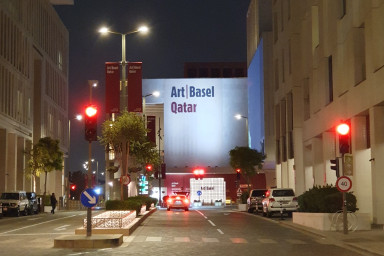
In the run-up to Art Basel Qatar, Melanie Gerlis paints a nuanced portrait of the Middle East marketplace for the Financial Times (possibly paywall): "Some gallerists have privately voiced concerns over the regime's rules against same-sex activity, illegal in Qatar, and its workers' rights record, for which it was criticised during its 2022 hosting of the football World Cup. Issues of self-censorship, at least, seem inevitable, though exhibitors say that Art Basel has not issued any advice on what they should or shouldn't bring. Their gallery selection process is, however, based on project proposals received in advance. [...] ‘There appears to be a tendency among the more influential segments of the art trade, particularly major fairs and auction houses, to cluster in tax havens,’ says James Goodwin, author of The International Art Markets (2009). Qatar, as well as the UAE and Saudi Arabia, has no income tax for residents and attractive corporation tax regimes. Goodwin finds that “historically, international art markets have tended to develop through stages: countries first trading in their own art, then foreign art, and ultimately engaging with the international avant-garde.” Galleries in the region reject the flash cash narrative, characterising instead a well-timed step change.
Uri Binnun of Tachles in Switzerland expresses concerns about Art Basel Qatar: "The fact that Western galleries, auction houses and museums are overlooking some of the ethical concerns may certainly have to do with the enormous financial resources available in a dried-up art market. 'Art Basel operates in a number of international environments where it can collect works. There is obviously a financial relationship between Art Basel and Qatar that involves money. There is clearly a shift of art to the Middle East that is also motivated by financial interests,' notes gallery owner Benjamin Evans from Landau Fine Art. [...] Specifically, with regard to participation in Art Basel Qatar, there are security concerns for Jewish and Israeli artists and gallery owners during their stay in Qatar due to the tense situation in the Middle East and the close relations between Qatar and Hamas. The Israeli National Security Council consistently advises Israeli citizens against any travel to Qatar due to the increased motivation of local terrorist actors to attack Israelis and Jews."
In a second round, Sotheby's has bundled and resold loans secured not only by works of art but also by cars, reports Daniel Cassady in Artnews: "The addition of collectible cars is the clearest signal of where Sotheby's sees the business heading. Rather than treating art lending as a niche service tied to auction activity, the company is positioning itself as a broader luxury-asset finance platform, capable of lending against everything from paintings to prized automobiles. [...] For the art market, the transaction hints at a quiet but significant shift. As auction sales remain uneven, lending has become one of the most reliable and scalable revenue streams for major houses, a trend widely noted across the auction sector in recent years. Whether that model holds up through the next market downturn remains an open question. For now, Sotheby's latest securitisation makes clear that art, and now collectible cars, are no longer just luxury goods—they're tools of finance as well."
Anne Reimers reports on last year's auction sales in London in the FAZ on 31 January: “The international art market has been on the upswing recently. However, London fell further behind New York last year. At Sotheby’s, this was not least due to the fact that the company concentrated its acquisitions on the major New York auctions in November, which were intended to mark the grand opening of its new headquarters in the Breuer building.”
The establishment of the Artists' Social Security Fund is a unique achievement worldwide and at the same time a competitive disadvantage for German galleries. The need for reform has long been recognised by all those involved. Daniel Völzke summarises the current discussion at Monopol: "Berlin gallery owner Jan Wentrup speaks of a “bureaucratic monster” that places a one-sided burden on a professional group that already operates in a high-risk market. The levy obligation is particularly difficult to understand in the case of foreign artists who will never benefit from the KSK. ‘No other country has such a special levy,’ says Wentrup – an argument that is repeated many times in the study. The Federal Association of German Galleries and Art Dealers (BVDG) also sees a structural distortion of competition. While German galleries shoulder additional social security contributions in international competition, their foreign competitors are not subject to comparable regulations.
Sarah Douglas explains gallery owner Gordon VeneKlasen's new plans following his departure from the Michael Werner Gallery in Artnews: "After running Werner's New York space for more than 30 years, VeneKlasen will take over that location, as well as Werner's London space, under his own eponymous gallery, and promote two longtime employees to partners. As part of the agreement, the short-lived Los Angeles branch of Michael Werner Gallery will close. Justine Birbil, who oversaw global operations at Werner, and Kadee Robbins, who headed up Werner in London, have both been made partners at VeneKlasen."
The Frida Kahlo Corporation, founded by the artist's niece, is not above anything, as collaborations with Shein and Barbie, among others, prove. Now you can even buy luxury apartments in the Frida Kahlo Wynwood Residencies in Miami, reports Carlie Porterfield in the Art Newspaper (paywall may apply). Kahlo, a staunch communist, would be thrilled. Nicolas Sarazin celebrates the project at Art Majeur: ‘Far removed from logos from the fashion or automotive industries, a historical figure who embodies art, politics and intimacy at the same time is becoming the centrepiece of a real estate project.’ The French marketplace claims to offer a ‘selection of over 3.5 million contemporary artworks’ and touts itself as one of ‘the largest art platforms in the world’.
An almost bankrupt gallery owner attempts to turn the tide with a daring appearance at Art Basel Miami Beach. The realistic-seeming plot is the starting point for a new film starring Natalie Portman, which Sophia Powers saw for Artnews: ‘The Gallerist is an entertaining romp through the farce and folly of the contemporary art world—low-hanging fruit, to be sure, but plucked with panache.’
According to Tessa Solomon at Artnews, over 130 US galleries, mainly in New York, joined the protest against the ICE deportation force under the slogan ‘ICE OUT’ and did not open last Friday. The FAZ has a news on this by Ursula Scheer.
Berlin gallery owner Johann König is suing Die Zeit for 1.2 million euros, report Ursula Scheer and Michael Hanfeld in the FAZ (paywall): "Gallery owner Johann König is suing the Zeit publishing house for an article in which he was accused of allegedly abusive behaviour, seeking an injunction, damages of one million euros and monetary compensation of at least 200,000 euros, both plus interest. He is objecting to a text that appeared under the headline “I shouted at him and insulted him so that he would go away” on 1 September 2022 in Die Zeit and the day before in Zeit Online. The case has been pending before the Press Chamber since the end of last year, according to the Hamburg Regional Court. It is being heard under file number 324 O 677/25. A trial date has not yet been set."
Monopol looks back on the life of the late New York gallery owner Marian Goodman: "Marian Goodman received numerous awards for her services, including the Légion d'honneur (2013), the Leo Award from Independent Curators International (2016) and, in 2023, the rank of Commander of the Ordre des Arts et des Lettres. In 2012, she was awarded an honorary doctorate from the CUNY Graduate Centre. Marian Goodman passed away on 22 January. The gallery will now be continued by long-standing partners."
semi-automatically translated