
Stefan Kobel
,
Kobel's Art Weekly 12 2026
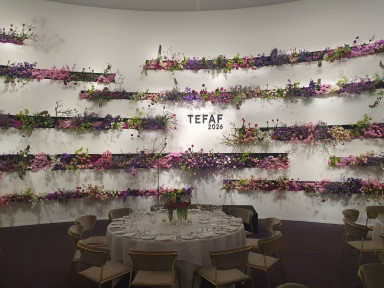
TEFAF in Maastricht impresses Brian Boucher at Artnews: “Despite global unrest and an ever-escalating conflict in the Middle East, the dealers interviewed by ARTnews at their stands at the TEFAF art fair in Maastricht – insofar as they were willing to discuss their sales – appeared more than satisfied – even if, as one dealer noted, collectors from the Middle East may not have been able to travel there. [...] Jörn Günther, a rare book dealer from Basel who has been exhibiting at TEFAF for thirty years, said this year had been his best.”
Ursula Scheer expresses hope for a generational shift in the FAZ (paywall): “Light, air and subtle correspondences between selected objects, on the other hand, are offered by the Roman antiquities dealer Alessandra Di Castro – a representative of a new generation who, with her gallery founded in 2009, nevertheless builds on a family tradition dating back to 1878. On the TEFAF Executive Committee, she belongs to the group of dealers tasked with steering the fair – founded 38 years ago and supported by a foundation – towards the future. There has been no continuity in leadership, and thus no clear strategic direction, for years: directors have come and gone in rapid succession, with five changes of personnel in four years. Following Dominique Savelkoul’s departure in December, members of the Executive Committee are now taking turns at the helm on a six-monthly basis; currently, it is Boris Vervoordt’s turn as President and Chairman.”
Rüdiger Heinze highlights the significance of TEFAF for the museum world in the Augsburger Allgemeine: “And because works of significance in every respect are available for purchase here in South Holland, Maastricht is also a year-round destination for museum directors and curators. In 2026, among those seen on the first few days were: Christiane Lange, director of the Staatsgalerie Stuttgart, who – as one could observe out of the corner of one’s eye – was interested in Gabriele Münter, as well as Hans [sic!] Hollein, director of the Metropolitan Museum of Art in New York, truly leading international experts.”
Even art by women has made its way to TEFAF, observes Christiane Meixner in the Tagesspiegel (possibly behind a paywall): “The number of female artists represented is striking, including Sonia Delaunay with a work inspired by geometric forms at the Galerie Zlotowski stand (€120,000) and Picasso’s lover Dora Maar, who is finally being recognised as a painter in her own right. However, her Cubist portrait of Picasso from 1937 at Galerie Boquet now costs as much as 700,000 euros.” On Artnet, Kate Brown points to an unofficial directory leading to art by women at Tefaf.
In the Aachener Zeitung, Belinda Petri highlights a problematic aspect (not only) of this fair: “Whilst the fair is regarded as an economic driver, XR criticises its carbon footprint. The activist group has announced plans to block the A2 motorway on 14 March. They are particularly critical of the fact that numerous guests are travelling to Maastricht Aachen Airport by private jet. As there is hardly any parking capacity there, many aircraft would fly on to Liège empty – additional emissions which, according to XR [Extinction Rebellion], are due to ‘pure luxury’. Aviation is one of the most climate-damaging sectors, with private jets leading the way: a short flight can equal the annual CO₂ emissions of an average European. The group also points to the upcoming A2 roadworks closures: if roads can be blocked for infrastructure, this must also be possible for climate protection.” I was in Maastricht for Artmagazine.
Meanwhile, the art fair crisis in Vienna continues. Olga Kronsteiner has investigated the state of affairs for the Standard. According to her report, ‘a Hungarian company’ has recently made an approach to several galleries in Vienna in mid-February. According to this, the so-called ‘Nova Vienna Contemporary Art Fair’ is set to take place at Messe Wien at the end of September: with a focus on the DACH and CEE countries, the aim is to attract 80 or even 90 selected galleries. A request from the STANDARD to the entrepreneur, who claims to have been organising art fairs in Hungary for over 30 years, remained unanswered. Similarly, management consultant, gallery owner and new fair organiser Frederik Lehner has entered the fray with a successor to the VC fair: the ‘qube Art Fair’, which is set to establish itself as the ‘leading annual fair for contemporary art’ featuring ‘selected top galleries from Austria, CEE and across Europe’. […] Initially, the fair was supposed to take place in November at the Austria Center. That turned out to be too short notice, however. According to Lehner, it is set to take place for the first time at the Marx-Halle at the end of November 2027.” And according to the one-page website, it is also due to take place at an unspecified date at the Arena Berlin. According to Northdata, Lehner has also been running Lehner Kunstauktionen GmbH in Vienna since 2016, which has reported losses and negative equity in its last two annual accounts. So it seems not much is changing in Vienna.
Marcus Woeller looks at the art fairs in the Gulf region in WeLT: “Without reliable international air travel, the region is geographically cut off, making a fair realistically almost impossible to stage. At least the load factor of the main airline, Emirates, has risen back to 50 per cent, according to Art Dubai. Hope now lies in the local strength of the city of 3.9 million. A cultural ecosystem has grown in Dubai. It is home to several commercial galleries, auction houses and a growing number of private collections and institutional foundations. ‘The city has proven itself to be extremely resilient in the recent past’, and the fair’s spokesperson, who says the event is set to take place as usual at the magnificent Madinat Jumeirah resort in the shadow of the Burj Al Arab, believes “‘that it will emerge from this situation stronger than ever.’”
Ursula Scheer has read the new Art Basel and UBS Art Market Report 2026 (PDF) for the FAZ (paywall): “Based on this, a picture emerges with both bright and dark spots. The rise in global art market turnover to an estimated $59.6 billion compared with 2024 does mark a turnaround following two previous years of declining turnover, but it is concentrated at the very top of the market – and, on balance, remains well below the record figure of $67.8 billion in 2022.”
Daniel Cassady of Artnews takes a particularly critical view of one market segment: “For much of the past decade, the art market behaved as if history had stood still. Collectors and speculators chased after works whose paint was still wet with missionary zeal, convinced that the next studio visit could yield a future masterpiece (or a decent return on resale in the secondary market). The auction houses catered to this desire, turning evening auctions into spectacles for artists who had barely had time to build a reputation. This fever seems to be over, according to the latest Art Basel & UBS Art Market Report, authored by economist Clare McAndrew of Arts Economics. Whilst the global art market returned to modest growth last year, reaching an estimated turnover of US$59.6 billion – a 4 per cent increase following two years of decline – auction sales for post-war and contemporary art continued to fall. These categories generated US$4.5 billion last year, compared with US$8.5 billion in 2021.”
Scott Reyburn outlines the criticisms of the report in the New York Times (may require a subscription): “The annual Art Basel and UBS Art Market Report is the only comprehensive survey of this specialised economic sector that covers both auctions and dealer sales. Its auction data is drawn from publicly available sources, whilst private dealer sales are estimated based on survey responses from gallery owners, of whom there were 1,650 this year. Although it is regarded as the industry’s most authoritative economic study, the use of self-reported information from a relatively small sample of dealers has led some experts to question the findings of previous reports.” I read the report for Monopol and Handelsblatt.
Drawing on publications by galleries and auction houses in the British equivalent of the Federal Gazette, Anna Brady and Anny Shaw conducted research for the Art Newspaper (possibly behind a paywall): “All four major auction houses are ultimately owned by an offshore parent company, such as [Sotheby’s] Drahis, which means that the true, comprehensive picture of their finances is ultimately obscured.”
In the Weimer case, Claudius Seidl adds his two cents in the Süddeutsche Zeitung (paywall): “If bookshops are being monitored by the Office for the Protection of the Constitution, no Minister of State for Culture needs to invoke freedom of opinion and the arts any longer. When the authority he heads lies so blatantly, one doesn’t want to hear another word from him. On no matter whatsoever, absolutely none.” In the FAZ, Jürgen Kaube comments: “The man seems not to know what he is on about. Seems to forget immediately what he said just a moment before. Seems indifferent to all his missteps. Recipients of mail from his ministry will draw their own conclusions in future. One can no longer believe him or the Minister of State; he is ruining his office.” With his authoritarian tendencies, Wolfram Weimer could merely be a trial balloon for the Interior Minister, suggest Markus Balser and Ronen Steinke in the Süddeutsche Zeitung (paywall): “For, according to research by the Süddeutsche Zeitung, the Federal Ministry of the Interior under Alexander Dobrindt (CSU) is urging other ministries and federal authorities to follow Wolfram Weimer’s example. There is talk of a nationwide initiative: government bodies, it is said, must ensure that funding does not flow to extremists. No money should be granted to individuals or groups about whom the Office for the Protection of the Constitution has relevant information. Authorities would then actually have to consult the Office for the Protection of the Constitution on every application before disbursing funding to citizens, in whatever form.” The left-wing Greens will probably think twice before applying for federal funding for their heat pumps or solar panels.
Furthermore, Weimer has told the German National Library to ‘go and eat cake’, and has cancelled its urgently needed extension. Nikolaus Bernau reminds us in the Tagesspiegel (possibly behind a paywall) of the federal government’s obligations: “By halting the Depot construction project, however, Weimer is also calling into question the federal government’s legal duty to provide the DNB with adequate funding and to guarantee its ability to function. It was only because the federal government assumed this duty that the Länder, particularly Bavaria and Berlin, agreed in 2006 to award the centralised honorary title of ‘National Library’ to Leipzig and Frankfurt, despite all federal reservations. It is solely for this reason that Weimer now has the power to decide, in principle, on reorientations or construction halts.”
semi-automatically translated