
Stefan Kobel
,
Kobel's Art Weekly 16 2026
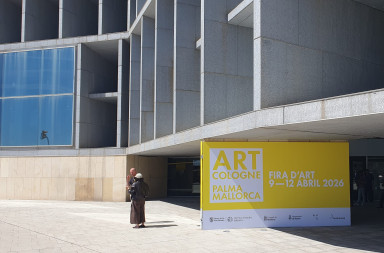
Josie Thaddeus-Johns presents Art Cologne’s second attempt in Palma, Mallorca, on Artsy: “Enter Art Cologne Palma Mallorca 2026. Although the fair will certainly be attractive to Spanish collectors, its German roots are unmistakable. On the fair’s VIP day on 9 April, a gallery owner remarked that the audience was predominantly German, many of them owners of second homes on the island. This creates a focused audience with high expectations. High-priced works, including a €1.3 million ($1.53 million) piece by Anselm Kiefer at the stand of the Berlin- and Palma-based Kewenig Gallery, showed that the Art Cologne tradition was very much present. [...] In keeping with the venue, the galleries seemed to be targeting a more relaxed buyer than one who would visit the German Art Cologne. Some visitors wear linen suits, others turn up in flip-flops. Nevertheless, this does not appear to be a fair aimed at brand-new buyers, but rather at enthusiastic collectors in holiday mode.”
In the Tagesspiegel, Christiane Meixner expresses her delight: “No comparison with 2007, when Hug’s predecessor organised a similar event at Art Cologne in a hangar at Palma Airport. After one edition, it was over; for two decades afterwards, there was no further talk of an art fair in the Balearic Islands. But Mallorca, says Hug, has changed: There are more renowned galleries on the island, the local association and public funding. And the explicit desire for a new quality of tourism. Hug has turned this into an exciting mix. Stands start at twelve square metres, with two different starting prices depending on the age of the galleries.”
Georg Imdahl discusses the external circumstances in the FAZ (paywall): “The hospitality of the Art Palma Contemporani gallery alliance included the requirement that all twelve members be able to participate. This wish was apparently non-negotiable and is not entirely beneficial for the programme.[...] Meanwhile, on the eve of the opening, Zurich-based gallerist Damian Grieder invited guests to his private home for a pop-up exhibition by Christian Jankowski. Mallorca can score points with events like this. Perhaps the German-Spanish fair is also benefiting from the uncertainties in the Middle East, which led to the postponement of Art Dubai.”
Georgina Adam discusses the advantages of the location in Europe in the Art Newspaper (possibly behind a paywall): “When asked whether the Gulf War was affecting sales, some exhibitors and visitors replied that Mallorca existed in a sort of bubble and therefore remained unaffected. Justus Kewenig of the eponymous gallery in Berlin and Mallorca, however, was of the view that the international situation could benefit the island. ‘Now that the Emirates, and Dubai in particular, are no longer a travel destination,’ he said, “wealthy holidaymakers are more likely to come here … it offers sun, sea and security!” And indeed, whilst the sea glistened directly behind the glass windows of the conference centre and a cheerful, sun-kissed crowd dined in the sun on the roof terrace, one exhibitor enthused: “It makes perfect sense to hold an art fair here!”” I was in Mallorca for Monopol and Artmagazine.
Internationally, Art Paris has received little attention. Reporting for Euronews, Mohammad Shayan Ahmad says: “Overall, the show is broad in scope and explores many different sub-themes. The ‘Promises’ section, dedicated to younger galleries, brings together 27 exhibitors, many of them appearing for the first time. It is one of the fair’s most dynamic zones, with a clear focus on emerging artists and a notable proportion of women. At the same time, the fair is further expanding its design profile. Following its debut last year, the French Design Art Edition returns and has grown to 17 exhibitors – ranging from studios to interior designers.” The displacement of Fiac by Art Basel is a boon for Art Paris, notes Sarah Moroz in the Observer: “The market in Paris has changed significantly in recent years,” reflected Garrett Landolt, director at Esther Schipper, at a stand one aisle away from Almine Rech. “Initially, it was quite a local market: Parisians bought from Parisian galleries. With the arrival of Art Basel, it has become so international in recent years. We’ve heard from some that Art Basel Paris has now become so prestigious that Art Paris is suddenly more accessible and perhaps more interesting because there are different price ranges. This attracts a wide variety of visitors.” He highlighted not only the “quality of the advisors and collectors” who dropped by, but also that visitors were curious about the works on the stand and took the time to ask questions – in contrast to buyers at Art Basel, who rush to snap up the works they want.”
The focus on its regional strengths is doing Expo Chicago good, according to Maxwell Rabb at Artsy: “In early conversations, one theme kept coming up: the fair felt refreshed. This shift attracted collectors from the Midwest who hadn’t been there for years, as well as a larger international audience. The 2026 edition is the third EXPO under the management of the Frieze group and the first under the leadership of Kate Sierzputowski, the fair’s former artistic director. In collaboration with the renowned Chicago-based curator Essence Harden, she has introduced a more streamlined layout and a clearer curatorial vision, reducing the fair to 140 galleries compared to 170 in 2025. Leaner, more determined and more focused, this year’s EXPO feels revitalised. The fair got off to a lively start, with several stands selling out within the first few hours.” Natalie Jenkins asks on Hyperallergic whether and how art fairs benefit the local scene: “Amidst the countless active artists, underpaid art administrators and wealthy, often well-meaning art lovers who have money to spare for $40 tickets and $7 bottles of Dasani, the question arises: What does Expo Chicago (and its cluster of neighbouring fairs) actually do for the local art scene? The obvious answer is the boring one. Art fairs sell art. But in reality, this purpose breaks down into something more complex. Perhaps the most interesting way to experience the fair week in Chicago is as a kind of vivisection of the Midwestern art ecosystem, laying bare our pulsating, bleeding heart within. At the Expo itself, a more compact fair reveals both the joys and the vulnerabilities of Chicago’s current creative landscape.” Brian Boucher reports on numerous sales for Artnews.
Artist Josh Kline denounces the increasingly difficult economic conditions for art production in the US, and particularly in New York, in a widely acclaimed essay in the journal October. Alex Greenberger picks up on the text for Artnews: “Kline’s essay, titled ‘New York Real Estate and the Ruin of American Art’, published in October, is a desperate portrait of the city’s art scene. It serves both as an elegy to a lost New York art world of the 2010s – the one that produced Kline, an artist known for his work on technology’s capacity to exacerbate inequalities – and as a scathing critique of all the privileges required to succeed here. The piece has gone viral, something that no longer happens often with October essays.” Even Frauke Steffens reports on the FAZ (paywall).
In light of recent events, Olga Kronsteiner takes a close look at the art trade’s handling of Otto Mühl’s work for the Standard: “There, the strategy being pursued is the one that Klaus-Albrecht Schröder, as director of the ‘Vienna Actionism Museum’, has been calling for for weeks to safeguard his employers’ investments: a ‘separation of life and work’, which 41 former members of the Mühl sect from the parents’ generation now vehemently oppose in a guest commentary in Der Standard.
According to them, such a ‘separation’ is untenable simply because the production of art was ‘part of the Mühl sect’s system of marketing and obfuscation’. After decades in which the art trade, in the slipstream of museum exhibitions, hyped up the artist-guru as a key figure of Viennese Actionism, a critical examination is evidently proving difficult.”
Harrison Jacobs reports in Artnews on the out-of-court settlement in the NFT scene’s most high-profile legal dispute: “A protracted legal saga between Yuga Labs, the parent company of the Bored Ape Yacht Club, and the artist Ryder Ripps and his business partner Jeremy Cahen has finally come to an end after the parties agreed to a settlement on Tuesday. Although the terms of the settlement are confidential, the parties announced that they have agreed to a permanent injunction prohibiting Ripps and Cahen from using any trademarks or images owned by Yuga Labs.” What is the basis for the value in dispute in such cases – the value of NFTs at the time or their current value?
Tessa Solomon reports on new Greek legislation regarding cultural heritage in Artnews: “The bill, passed by parliament at the end of January, provides for strict criminal sanctions commensurate with the severity of the offence, including prison sentences ranging from six months to ten years and fines of up to €300,000 in the most serious cases. It also broadens the legal definition of art fraud to include issues of provenance, condition and attribution, whilst clarifying what constitutes protected cultural property – with the scope extended to ‘cinemas of historical significance’. Under the new bill, works identified as forgeries are to be destroyed.”
A draft bill on the restitution of cultural property is due to be debated in parliament today, Monday, reports Andy Battaglia, also at Artnews.
Fair Warning, the organiser of ultra-exclusive auctions, has a new partner in Saara Pritchard. She and founder Loïc Gouzer discuss their plans in an interview with Daniel Cassady at Artnews: “First, we want to build the team. Then the technology. We’re rethinking how live auctions work on a platform – how to recreate that moment online. We’re also working on new ways to sell art. It’s still early days, but things will become clearer soon. The investor comes from the tech sector, so that plays a big role.”
Frieze has a new COO, reports Maximilíano Durón at Artnews: “With more than two decades’ experience leading blue-chip companies in the art world, Lasry brings a mix of auction house, art fair and gallery experience to Frieze. Most recently, he was Chief Operating Officer at Perrotin, overseeing logistics and operations across the gallery’s nine locations worldwide. Prior to his role at Perrotin, he worked at Art Basel from 2018 to 2023, rising to the position of Managing Director. During his tenure, he was involved in the launch of Art Basel Paris, which held its inaugural edition in 2022."
semi-automatically translated