
Stefan Kobel
,
Kobel's Art Weekly 2026
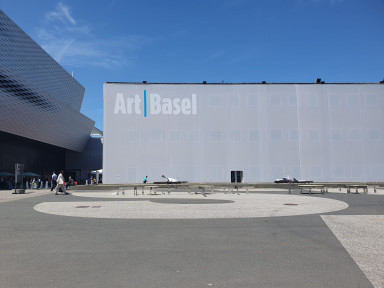
In his report in WeLT on Art Basel, which he says “got off to a flying start”, Marcus Woeller peppers his piece with art market anecdotes: “Above all, however, it is the selling prices at Art Basel that are truly exclusive. The asking price of 35 million dollars, for instance, with which the Hauser & Wirth gallery announced the sale of a Picasso painting (‘The Painter and his Model in a Landscape’, 1963) on the first preview day, is likely to set a new record. The Swiss gallery claims to have sold a total of 35 works at the start of the fair. ‘The first day of Art Basel 2026 was a resounding success – stronger than ever before,’ announced the company’s president, Iwan Wirth.”
In the FAZ (paywall), Ursula Scheer initially makes a similar point: “The crowds during the preview days were enormous, and dealers are satisfied with their sales. The new ‘Basel Exclusive’ initiative is set to provide even more momentum: galleries bearing this label are holding back works from their collection until the first day of the fair and are not promoting or selling them online in advance. At Sprüth Magers, for example, this is a painting of a horse emoji by John Baldessari priced at 500,000 euros; at Zwirner, a work by Elizabeth Peyton costing 1.2 million dollars – which sold on the second day. Overall, however, collectors have become more cautious. In keeping with this, Art Basel in Basel is refraining from grand gestures on the surface. Instead of Katharina Grosse’s expansive spray art from last year, this time an unobtrusive fountain installation by the Iranian-Armenian sculptor Nairy Baghramian is reshaping the fairground. It is a study in metal and ceramics on obstacles and disruptions.”
Eva Komarek puts it somewhat less effusively in the Presse (paywall) from Vienna: “Art Basel has always been the barometer of the global art market and, not least, a place where the industry reaffirms its own significance. Anyone who wanted to know where the journey was heading had to come to Basel. This year, however, the question arises as to whether one really still needs to come. At the very least, this is the question one Viennese collector is asking herself ahead of the next edition. For indeed, the 56th edition of Art Basel, which runs until Sunday evening, lacked dynamism. Whilst the fair’s organisers tirelessly emphasise its role as the ‘flagship’ of the Art Basel empire, the opening days were conspicuously quiet. The crowds of previous years were absent, as was the hustle and bustle of the VIP days. Many Austrian exhibitors independently made the same observation: fewer visitors, fewer Americans, less pressure.”
Scott Reyburn pours a little cold water on the situation in the New York Times (paywall): “The problem, however, is that the focus is the other way round for many market players, particularly from the United States. The allure of Art Basel’s ultra-chic fair in Paris in October prompted several US-based exhibitors to pull out of this year’s Swiss fair. There were conspicuously fewer Americans browsing the stands, too. “The main American collectors are holding off until October,” said Wendy Goldsmith, an art adviser based in Palm Beach, Florida. “Paris has a better selection of hotels, restaurants and shops than Basel, so if they’re going to make a choice, it will now be Paris.”“
Alongside the latent xenophobia of the local population, Jens Müller in the Tagesspiegel (paywall) focuses on the consequences of the fair organisers’ former megalomania: “In the new ‘Zero 10’ exhibition area for digital art, the Sprüth Magers gallery has installed ‘Ocean V’ (2010). […] Both works could just as easily have been shown at the other venue. One might be forgiven for thinking that the fair’s primary concern was simply to somehow fill its oversized portfolio of halls with new sectors. The Liste fair, as the most important satellite fair for the past five years now, also owes its location to this (excessive) supply of space; prior to that, it was housed in a former brewery.”
Kabir Jhala reports in the Art Newspaper (possibly behind a paywall) on the tacit discontinuation of the renowned Baloise Art Prize, which until now had been awarded annually at Art Basel to an artist from the ‘Statements’ section.
Georg Imdahl embellishes his tour of the satellite fair for the FAZ (paywall) with a Freudian slip: “Whilst Art Basel is hosting around 290 exhibitors this year, the participants in the other events on both sides of the Rhine add up to an even greater number of exhibitors. The city is teeming with museum professionals, collectors, curators, artists and enthusiasts from all over the world who are involved in art in one way or another. A stimulating sense of stress and the nervousness of perhaps missing something worth seeing mingles with the general urge for more and ever more art. In the oppressive summer heat, this creates Basel’s inimitable energy. So, in the tranquil Rebgasse, one is happy to immerse oneself in Photo Paris [!] with its 40 participants”.
Lydia Huckebrinck describes the Basel Social Club phenomenon for SWR: “‘Basel Social Club is a bridge between art and life. What is art and what isn’t art?’ says [co-founder Yael] Salomonowitz. The Social Club is perhaps the only place during Art Basel where absolutely everyone comes together: collectors, gallery owners, fair professionals, but also families from Basel, tourists and, last but not least, the local art scene. It’s almost impossible to tell them apart in this place. For hours on end, you wander through the corridors of this seemingly boundless art cosmos, pausing at the quirky exhibits, stumbling across subversive installations. In the evening, the building’s underground car park turns into a club, with performances and DJ sets lasting well into the night.”
I was in Basel for Artmagazine and the 19 June edition of the Handelsblatt.
Marc Spiegler has published a ‘Stop the Thief!’-style essay in the New York Times (paywall), in which he observes that many galleries have focused on expansion and ever-greater reach: “Over the last two decades, contemporary art has become part of pop culture, with flashy museums opening in cities around the world, attracting selfie-taking tourists. Art fairs proliferated, and sometimes, as with Art Basel Miami Beach, became cultural events in their own right, attracting celebrities and plenty of media attention. The problem is that the art-selling business itself hasn’t kept pace with the hype. More museums and biennials mean more exhibitions that galleries have to support. Participating in fairs involves built-in costs that don’t always pay off. There simply aren’t enough collectors – especially new collectors – to make the figures add up in this supersized art world.” Who was it, during precisely this period, who was head of Art Basel and who, at every opportunity, claimed that the Art Basel fairs brought the best art by the best artists from the best galleries to the best collectors and the best institutions everywhere? It is somewhat surprising that someone should be criticising the very system that he himself helped shape in a key position.
Half of the women in middle management in the art world were planning to leave the industry within the next five years, according to Margaret Carrigan’s summary of the findings from the report “Hardwiring Change: Buying Back Time” by Artnet and the Association of Women in the Arts (AWITA) on Artnet: “What struck me most is how many Gen Z and millennial-aged women are considering leaving the industry within the next five years: nearly half. That figure suggests that many of the workers who should be moving into leadership roles and hiring the next generation of arts professionals are instead questioning whether they can afford to stay. [...] What emerges from our research this year is a portrait of an industry asking highly skilled workers—mid-career women, in particular—to put up with financial instability, administrative overload and structural inequalities. More than half of respondents identified fair pay and job security as the most important factors in sustaining a career.”
semi-automatically translated