
Stefan Kobel
,
Kobel's Art Weekly 22 2026
The most comprehensive analysis of New York’s auction week is provided by Zachary Small, Julia Halperin and Tim Schneider in the New York Times (possibly behind a paywall): “Months of speculation led up to this moment, a symbol of the industry’s attempt to regain its footing after four years of fluctuating sales. It worked. Apart from the seven-minute bidding war that drove the value of the Pollock painting to a record price of $181.2 million, many works of art at the auctions exceeded their high estimates, with some setting new auction records. Christie’s, Sotheby’s and Phillips ultimately sold artworks with a total value of $2.5 billion, including buyer’s premiums, compared with $1.3 billion at the corresponding auctions last May.” Beyond the raw figures, the article also addresses the themes of guarantees, new collectors, new markets, old white men and the ultra-contemporary. Essentially, this is the one article you should read.
Anne Reimers picks up on the promotional video featuring Nicole Kidman—which, in the run-up to the auction week, was enough to make one cringe—in her follow-up report for the FAZ: “In a promotional film commissioned by Christie’s, the Australian Hollywood actress dances to David Bowie’s ‘Golden Years’ around Brancusi’s gilded ‘Danaïde’ from the collection of media mogul S.I. Newhouse, who died in 2017 and who sought advice from Meyer on art matters. The video is said to have been [former Sotheby’s star auctioneer Tobias] Meyer’s idea. During a visit to the current Brancusi exhibition at the Neue Nationalgalerie in Berlin, one can make the comparison with similar sculptures for oneself. The marketing spectacle paid off – or perhaps the art, its rarity and provenance spoke for themselves: The ‘Danaïde’ achieved the second-highest price ever paid for a sculpture at auction during Christie’s ‘Masterpieces: The Private Collection of S.I. Newhouse’ evening sale in New York. After around half a dozen bids, the hammer fell at $93 million for one of six known versions of the work.”
In WeLT, Marcus Woeller points out: “Records have an enormous psychological effect on the industry, but they are not a reliable signal of a new beginning for the broader market. Once again, a few extremely expensive works of art have driven the total sum into the nine-figure range. However, the fact that a significant proportion of the lots were backed by guarantees puts the significance of the results into perspective. Spectacular figures are simply not necessarily representative. Above all, they show that very wealthy collectors and investors are once again prepared to bid aggressively for masterpieces.”
For Monopol, I take stock of the evening auctions in New York.
Reporting from Vienna, Nicole Scheyerer writes for the FAZ (paywall) about an auction record for an Italian artist: “The Vienna Dorotheum set a new record for Carla Accardi at its contemporary art auction. Since the artist’s death in 2014, her market value has risen significantly. Accardi’s double-sided screen ‘Fonda notte – Pieno giorno’ features the typical biomorphic forms of the symbolic vocabulary she developed from the 1950s onwards. The wooden screen, created in 1986, changed hands for an outstanding €400,000 net – ten times its low estimate.”
From her tour of the galleries at Various Others in Munich, Veronika Beck has brought back more than just the usual checklist for Artmagazine. She actually engages with the content and sees this year’s edition as a ‘playground for trans-significance’: ‘Various Others is an event that does not prescribe a specific theme. Each edition thus moves along a spectrum, somewhere between an exclusive gallery circus and an authentic barometer of the present. This year, some contributions reflect the state of a post-secular society in which religion clearly persists as a cultural force. What is emerging is a spiritual playground where identity, aesthetics and political projections intermingle unchecked.”
In Vienna, collectors have joined forces to make their treasures accessible to a wider audience, reports Werner Remm in Artmagazine: “What is striking about all those involved is the joy they take in sharing their passion; some organise small exhibitions themselves on a regular basis, whilst others sit on museum acquisition panels. The association aims to share the joy of buying art and engaging deeply with it with an even wider audience in future. The ultimate plan is to find a space to display a constantly changing selection of works from the members’ collections. May the virus of art buying spread as far and wide as possible.”
Paco Barragán explains the origins of what he calls the Global Neo-Liberal Biennial (GNB) and its role in the art market in a detailed essay in the Observer: “This intertwining of exhibition and market is not a new development, but is operationally anchored in the history of the Venice Biennale itself. As the Italian scholar Clarissa Ricci has explained, the artworks exhibited at the Biennale could be sold directly from its founding in 1895 until the de facto end of its sales office in 1972 – which was officially closed in 1973. Between 1942 and 1972, the Italian dealer Ettore Gian Ferrari was the official agent, charging a commission of 15 per cent to the Biennale and 2 per cent to himself on the works he brokered. Art was not only exhibited in Venice, but also systematically traded.”
Annika von Taube recommends that art market players at Monopol use LinkedIn: “If you consider, for example, that most people use LinkedIn in a professional context and during working hours, you can also market the fact that viewing art reduces stress and improves concentration as a nice side effect. In the end, you kill two birds with one stone: you engage new target groups and, at the same time, breathe new life into a social media platform in need of a revamp in terms of originality.”
Nadia Anwar-Watts explores Gen Z’s enthusiasm for Mark Rothko in the Guardian: “On TikTok and Instagram, videos centred on Rothko’s work are racking up hundreds of thousands of views.
One creator has started styling outfits inspired by individual Rothko canvases; another assigns Rothko works to personality archetypes and describes Untitled (Yellow and Blue) as fitting for ‘someone who gets up early, drinks citrus water and has their life under control – or at least appears to’. Elsewhere, users compare his atmospheric colour palettes to the sombre melancholy of the Cocteau Twins – the dream-pop band currently enjoying a renaissance among Generation Z.”
Patricia Wolf describes the precarious situation of studio houses in Berlin in the Tagesspiegel (paywall): “The building on Schönfließer Straße is therefore also a symbol – of a city that likes to present itself as a cultural metropolis, but creates ever less space for those who sustain that culture. […] For the question is no longer how artists work. Rather, it is whether a city like Berlin creates the conditions under which they can and want to stay.”
Bernhard Schulz assesses the plan to protect art and culture from drastic cuts via a cultural funding law in the face of a looming AfD-led government in Saxony-Anhalt for Monopol: “For they [the AfD] state menacingly in their manifesto that ‘artistic freedom’ is ‘not a claim to have everything and anything funded’. And further: ‘That is why we will use state and taxpayers’ money primarily to fund art that contributes to the formation of a German identity.’ The door is wide open to interpretations of what serves the ‘formation of a German identity’; certainly not the Bauhaus, as exemplified in Dessau. Theatres are to stage more ‘German plays’, and in general there must be ‘no more state funding for anti-German art and culture’.
Wassan Al-Khudhairi will curate the second edition of Art Basel Qatar, as I report in Artmagazine.
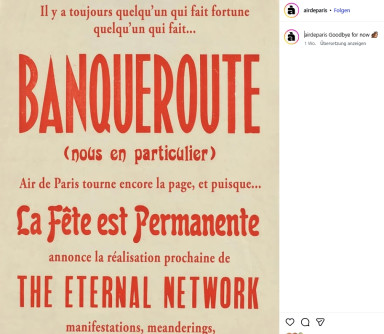
The Aire de Paris gallery has announced its closure on Instagram. Devorah Lauter spoke to the gallery owners for Cultured about the insolvency and changes in the art market: “Bonnefous and Merino decided to close primarily due to the gallery’s ‘precarious’ financial situation, Bonnefous’s health (she suffers from chronic obstructive pulmonary disease), Merino’s own fluctuating health, and a simmering refusal to participate in the art industry’s increasingly profit-driven ‘management efficiency’, [...] A year ago, the gallery owners withdrew from Art Basel in Basel after their stand had been downgraded. In a letter, they criticised a ‘trend towards a more corporatist model’ in the art trade. Nevertheless, in recent years, supported by close ties to institutions and collectors, we have tried to ‘carry on without taking the easy route or prioritising profit’, said Bonnefous. “It is all the more surprising that we have held out for so long.”
The robbery at the Louvre is being made into a film, reports Charles Boutin in the Figaro.
A New York court has found the ex-husband of New York gallery owner Brent Sikkema guilty of murder, reports Kelly Crow in the Wall Street Journal: “A federal jury found Daniel Sikkema guilty on Friday on three counts of conspiring to hire and pay a hitman to kill the 75-year-old dealer, who was holidaying at their second home in Rio de Janeiro two years ago.”
Marian Gambino and Christiane Vielhaber pay tribute to the late Cologne gallery owner Knut Opser in the Kölner Stadt-Anzeiger: “He found it difficult to give up his gallery space. ‘I’d have to be 20 years younger, then I’d carry on,’ he said during a visit a year ago. Knut Osper closed his art gallery in Pfeilstraße at the end of May last year after 60 years. […] A year after the closing exhibition ‘Schatzsuche’, Knut Osper passed away on 11 May at the age of 81.”
semi-automatically translated