
Stefan Kobel
,
Kobel's Art Weekly 23 2026
Art is a poor investment vehicle. This should really be a truism, yet the misconception that this is not the case persists. Taking the example of the latest New York auction results – hailed by the auction houses themselves, art dealers and much of the press as a resurgence of the art market – Katya Kazakina demonstrates in detail for Artnet (possibly behind a paywall) that even a risk-averse investment in a passive index fund yields a higher return than art: “The notion that art is a reliable investment vehicle – and not merely a store of value – has become deeply entrenched in the market over the last five decades. It dates back at least to 1974, when the British Rail Pension Fund began investing around three per cent of its assets in art as a hedge against inflation. [...] Its collection was sold off in the 1980s and 1990s. The returns – widely reported at around 11 per cent annually, a figure questioned by some analysts – helped lay the foundation for the belief that art is a reliable investment. Since then, the trend has accelerated dramatically. The number of investment funds multiplied. Banks expanded their art-backed lending and hired specialist advisers. Deloitte and AXA Art began publishing annual reports in which art was presented as an alternative asset class. Speculators traded works by emerging artists as if they were IPOs. But no frenzy lasts forever. Bubbles in the emerging art sector have burst time and again. The results of the British Rail Pension Fund remain unmatched”.
New York gallery owner Marc Staus sees the gulf between the market’s elite and everyone else, as highlighted by Hyperallergic, as a warning sign: “The system is not healthy, and after Pollock we are led to believe that everything is going swimmingly – perhaps even brilliantly – in our important art universe. It isn’t. And these results are so infuriating to so many. As if the art market were a playground for the super-rich. That is true and not true. The art market has tens of thousands of artists, most of whom are struggling, creating things we didn’t ask for, and enriching our lives. We need them, and we need the galleries.”
Art critic Jerry Saltz seems to have had a veritable Max Liebermann moment at the auctions, as his piece for Vulture (paywall) suggests: “Auction houses pretend this is a ‘market’.” It is not a market. It is a tiny oligarchy: a dozen or so global bidders, a handful of mega-dealers, several auction houses and a growing entourage of advisers, consultants, influencers and hangers-on who profit from proximity to unimaginable wealth. “The auctioneer stages this competitive frenzy for public consumption. Gorgeous X-rays whisper into phones, whilst invisible billionaires hover somewhere in New York, Dubai, Monaco, Beijing or upstairs. Everyone else watches as if concentrated wealth were in itself proof of cultural significance.”
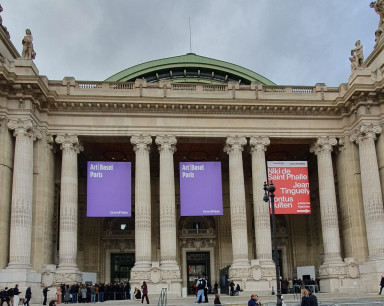
The participants in Art Basel Paris have been confirmed, I report in Artmagazine. Jo Tncred-Lawson has tallied the arrivals and departures for Artnet: “Among those not taking part this year, having participated last year, are the Andrew Edlin Gallery (New York), dépendance (Brussels), Lia Rumma (Milan, Naples), Jan Mot (Brussels), Kiang Malingue (Hong Kong) and Balice Hertling (Paris), which recently informed Artnet News columnist Kenny Schachter that it was in arrears with payments to its artists.”
It is not only in the UK that artists often lose out when their gallery goes bust. In the Art Newspaper, Jon Sharples explains the legal situation there: “I have written about this here before: how poorly protected artists in the UK are when their galleries go bust, with artists forced to join the hopeless queue behind creditors such as banks and the tax authorities when there is hardly anything left to distribute. In this regard, the problems are at least somewhat known and understood, even if a solution remains elusive. Another challenge that has received less attention is the question of what to do when external storage providers commissioned by the now-closed gallery have not been paid and refuse to release works to the artists until the outstanding payments are settled.”
Dealing with Nazi-looted art remains a bumpy process. The arbitration tribunal is not (yet) well received, and there is no legal solution for restitution from private ownership. Minister of State Wolfram Weimer wants to change this, but is keeping his cards close to his chest, laments Klaus Hillenbrand in the taz: “Whether the Restitution Act is to include a fund-based solution remains unknown. Minister of State for Culture Wolfram Weimer (independent) remains tight-lipped on the matter. Initial drafts are reportedly in the works – that is all that has been elicited from him so far. And that he hopes for its adoption before the end of this legislative term. His response to a detailed questionnaire from the taz on the subject is brief.”
What lies in store for the entire cultural scene should the AfD come to power anywhere can be surmised from statements by its officials, as Julian Steib has researched for the FAZ (paywall): “[Thore] Stein explained in the plenary session at the time that the AfD was by no means planning an attack on free art. But a ‘national-conservative party’ simply has different ideas about art. What is often proclaimed as art today is ‘no longer comprehensible to the vast majority of people’. Only an ‘elitist little caste’ revelled in having to ‘portray itself as increasingly irrational’. ‘For the vast majority of people, that is not art.’” However, it is not just some CDU/CSU supporters who are likely to feel addressed by such statements.
It is more of a scandal involving public service broadcasting in Austria than an art market scandal that Olga Kronsteiner has uncovered for the Standard (now with free registration) and the investigative podcast Die Dunkelkammer: For the series “Wa(h)re Kunst” (YouTube video), a freelance producer is paid a four-figure sum in production subsidies by the very subjects of his reporting – art dealers and gallery owners. When the ORF airs an episode, he typically receives a three-figure sum per broadcast.
In the FAZ (paywall), Ursula Scheer laments: “‘Wa(h)re Kunst’ is certainly not driven by investigative zeal, as demonstrated most recently by the latest episode, which was first broadcast in September last year: It focuses on successes and sensations in Vienna’s art market, rather than the ongoing art fair disputes in the city, a suspected case of smuggling involving Klimt’s rediscovered painting of the ‘African Prince’, or an auction flop such as the difficult sale of Klimt’s much-hyped portrait of ‘Fräulein Lieser’ at the Kinsky.”
However, it would be wrong to blame the lack of journalistic distance on the market participants. The ORF, however, shows a complete lack of awareness of the problem, writes Kronsteiner: “Accordingly, the ORF has ‘neither the task nor the means to question the financing of products it purchases’. With regard to legal requirements, it states succinctly: ‘Since all programmes in the relevant purchase series have been editorially assessed and approved’, ‘the ORF Act has in any case been complied with’.”
Harrison Jacobs reports further personnel changes at Christie’s in Artnews: “The auction house has appointed François-Henri Pinault as Chairman and non-executive director. Pinault is the son of French billionaire François Pinault and President of Groupe Artémis, Christie’s long-standing parent company. [...] Guillaume Cerutti had held the chairmanship since 2023, having served as CEO of the auction house from 2017 to 2025. Following his resignation as CEO, Cerutti remained Chairman of the Board and President of the Pinault Collection. Earlier this year, Cerutti stepped down from his position at the collection. François Pinault is now listed as President of the collection.”
Anyone who understands the art of cooking as such will soon have yet another reason not to buy a newspaper. Jürgen Dollase, Germany’s leading food critic, has announced on Facebook the immediate discontinuation of his column in the Frankfurter Allgemeine Sonntagszeitung: “My two main reasons are: 1. The professionally unqualified treatment of my work by the editors responsible for the ‘Genuss’ page. 2. I no longer wish my articles to appear alongside the often unspeakably banal pieces on this page. Naturally, I am grateful for the good times.”
semi-automatically translated