
Stephan
Zilkens
,
Zilkens' News Blog 16 2026
Another Monday, and with it a whole host of uncertainties that are slowly but surely beginning to have a significant impact on people’s travel habits. Art fairs are still taking place – those in Paris, Palma and Chicago have just come to an end. It remains to be seen, however, whether the Art Cologne spin-off in Palma, held a week before Art Düsseldorf, was able to capitalise on the holiday atmosphere and the finer weather. Some galleries are taking part in both fairs – a major challenge that some gallery owners view critically. Inspired by an essay by Josh Kline, “New York Real Estate and the Ruin of American Art”, Johann König writes on LinkedIn: … What I find particularly interesting about it is his analysis of art fairs. Because if we’re honest: art fairs today are nothing more than the high streets of the art world. And the bad ones at that. The ones where every street looks the same. The ones where the same shops are everywhere. The ones where, after five minutes, you no longer know whether you’re in Frankfurt, Dubai or Shanghai.
That’s exactly what art fairs feel like. The same layout. The same booths. The same names. The same aesthetic. The same ‘safe’ positions. Everything is standardised, optimised, smoothed out. Risk is systematically eliminated. What remains is an interchangeable sales floor. Art is no longer discovered there – it is burned through. No longer shown – but channelled through. And at the same time, this system is extremely expensive and brutally inefficient. ... A few bad fairs – and a gallery is gone. A few wrong prices – and an artist loses their market. That is not a healthy ecosystem. It is an overheated system that destabilises itself.
One is entitled to a different opinion, and it happens time and again that one finds new positions at fairs that have not yet been fed into the mainstream circuit, as in Palma, the Positions or now also in Düsseldorf. There is a huge difference between the art trade and gallery work, and only a few gallery owners manage to be art dealers as well. Perhaps a debate will get underway that ultimately leads to a greater willingness among corporate management to surround themselves with art, as in the 80s and 90s when corporate collections were still a source of pride and not an asset class to be offloaded via the secondary market. (Bayer might then buy again instead of selling)
Sometimes a look back can be quite revealing: by April 1975, the EEC founded by the Treaties of Rome in 1957/58, which had started with six members (B, NL, LUX, D, I, F), had grown over two years to nine (+GB, IRL, DK). The President of the Council, Gaston Thorn, who was also Prime Minister of Luxembourg, expressed scepticism about future developments. The Belgian Tindemanns even anticipated a loss of what had been achieved so far. And within the CDU, the impression had taken hold that the latest enlargement had resulted in the Community being even less able than before to make decisions quickly and appropriately. Fifty years later, this view has become entrenched among broad sections of the population in all the countries concerned – yet none of those responsible for European policy are prepared to question subsidies, privileges, the organisation of voting or the structure of the Commission in order to move Europe forward. In Hungary, voters are even being incited against Europe by the American Vice-President. It has served no purpose! The EU member states should really all be summoning their respective US ambassadors now and protesting vehemently against this kind of interference. Perhaps they had intended to do so, but following Magyar’s overwhelming victory, that no longer seems necessary. Vance isn’t making the grade in Hungary, nor in the negotiations with Iran. Now his boss Trump is blocking the Strait of Hormuz. People, buy shares in American oil companies … . And the really shrewd ones are now checking who built up which positions in the stock market in good time. Trump’s Presidential Library has to be financed somehow, after all.
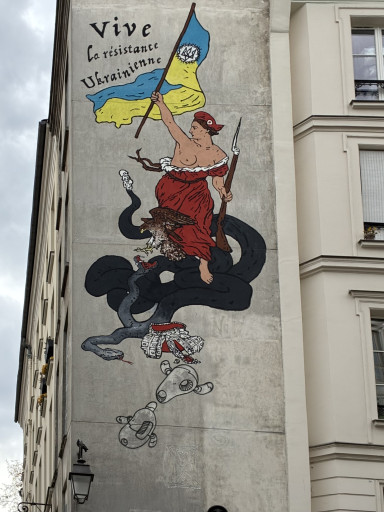
It should come as no surprise that the Easter truce announced by Putin was fragile. The fight for Europe’s freedom continues in Donbass and Luhansk – even without the support of American opportunists.
Not that anyone would get the idea that I’m interested in football, or even that I know anything about it! But I find it noteworthy that a woman is now becoming head coach of the Bundesliga team Union Berlin. If they were finally to knock the ‘dirty Bavarians’, as my grandfather used to say, off their throne… the republic would be grateful – because then money wouldn’t be everything in sport after all.
The insurance industry remains cautious in the face of all this and calculates war risks, if at all, in the single-digit percentage range. That too will be reflected in the prices. It could be a nervous week for us all – let’s stay steady…
Stay tuned – Stephan Zilkens and the team at Zilkens Fine Art Insurance Broker in Cologne and Solothurn
automatically translated