
Stephan
Zilkens
,
Zilkens' News Blog 4 2026
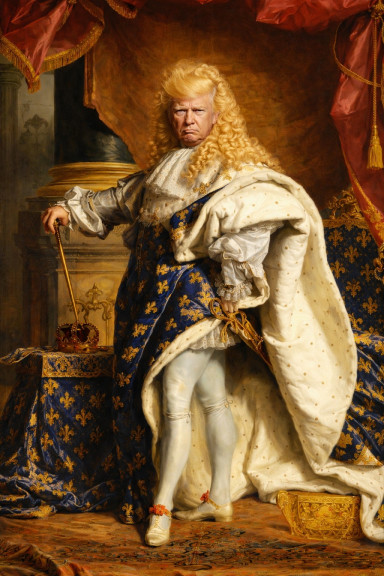
If you rule long enough, you can achieve quite a lot in the 17th and early 18th centuries. For Louis XIV, this included disempowering the nobility and pursuing an expansive foreign policy. The game of disempowerment played out through the various perfectly normal things that a living being has to do every day, such as getting up, getting dressed, working, eating and sleeping. The king exploited this publicly and created the petit and grand lever, and of course the petit and grand coucher at bedtime. The rank and esteem of the participants of all sexes – but in this case mainly male – was expressed by the respective entitlement to which rising or sleeping ceremony they were invited. Trump does something similar, if you look at the pictures from the Oval Office. It is interesting that, after 400 years, people can still be captivated by these means. It will be exciting in Davos this week. Let's hope it's warm and that the risk of slipping on frozen saliva is reduced. Last year's Nobel Peace Prize winner managed to slip even without black ice and presented the medal for her prize to the open blackmailer.
Mercosur could be a huge opportunity for Europe, despite the barking of French farmers. For the insurance industry, at any rate, if the protectionist measures in force in Brazil and the surrounding area are lifted. This could also be interesting for the insurance of art exhibitions and promote cultural exchange at the non-governmental level. Which brings us to the Bayeux Tapestry, which probably arrived in Normandy from the island 1,000 years ago. The current exhibition venue needs to be renovated, and Macron and Stamer could think of nothing better than to move it to the British Museum in London for a year. Even David Hockney doesn't think this is a good idea, because the materials are highly sensitive and partial loss of the original substance is quite likely. The British government is offering state liability for this – what else would you expect when £800,000,000 is at stake and you want to save on premiums? However, it is questionable whether state liability will apply if the fragile fibres crumble. This is considered an inherent vice or damage to the condition and is excluded. Of course, nowadays it is possible to make a perfect copy for the insurance value – it would probably be significantly cheaper – but would you want to see the copy if the original was lost? Or is the whole thing a clever move by Macron to get a subsidy from England for the culture budget? Things are much quieter around Vermeer's Girl with a Pearl Earring, which is due to travel to Osaka in August because the Mauritshuis in The Hague is being renovated.
The Kunsthaus Lübeck closed its doors on the fourth Sunday of Advent. The fact that the city had something more to offer than just the Holstentor in terms of art, and paper works in particular, was thanks to Frank-Thomas Gaulin and Klaus Oestmann, who successfully ran this gem of intellectual comfort for over 50 years. They are 82 and 88 years old, and there seems to be no successor on the coast. It's a shame, really – Lübeck is now a little poorer.
However, the state government of Schleswig-Holstein is more courageous, seeking to extricate itself completely from the clutches of Microsoft and switching its administration, including 44,000 email addresses, to open source providers. There are alternatives to Teams and Co – this example should set a precedent.
Cyber risks are now being talked about as the new fire risk because they can render companies completely incapable of acting. In comparison, the SPD's new plan for inheritance tax is almost a piece of cake, if it didn't hit the core of German prosperity – namely small and medium-sized enterprises – in favour of large international corporations. But envy is a citizen's first duty – Sweden manages quite well without inheritance tax. AI is emerging as a new risk for companies – somehow related to the internet and the www. Operational risks (AI learns from everything it reads and regurgitates it to anyone who asks a question), legal issues and reputational risks in particular can be associated with AI.
This week, the local trade fair circus kicks off with the House of Galleries at the Trianon in Frankfurt between the 42nd and 44th floors. Forty-four exhibitors are expected to give individual presentations. And the Frankfurt art trade is well represented. Let's keep our fingers crossed that the launch is a success. At the same time, Art Singapore is kicking off with several well-known galleries from German-speaking countries: Gisela Capitain, Ropac, Gmurczynska, Fuchs, Zilberman, Urs Meile, Von und Von and Neugerriemschneider. A few years ago, there was a market survey there with the BVDG. And then, on 23 January, BRAFA will also start, which feels a bit like a smaller version of TEFAF, at least when you look at the mix of art genres exhibited there. Art Genève is fortunate – there is no competition with other fairs on its date. But the following week, Art Karlsruhe, Art Basel Qatar and Arte Fiera Bologna are all crammed into the same date. Lucky are those who know how to transport art carefully and deal with customs formalities – they can help make the fairs a success for the exhibitors. In Miami, galleries without art have already been seen at fairs, but recently the model of galleries without gallery owners has also become popular because American border guards took issue with the fact that they wanted to enter the country as tourists.
Remain steadfast against emerging absolutism and enjoy what we hope will be a successful week.
Stephan Zilkens and the team at Zilkens Fine Art Insurance Broker in Solothurn and Cologne
automatically translated